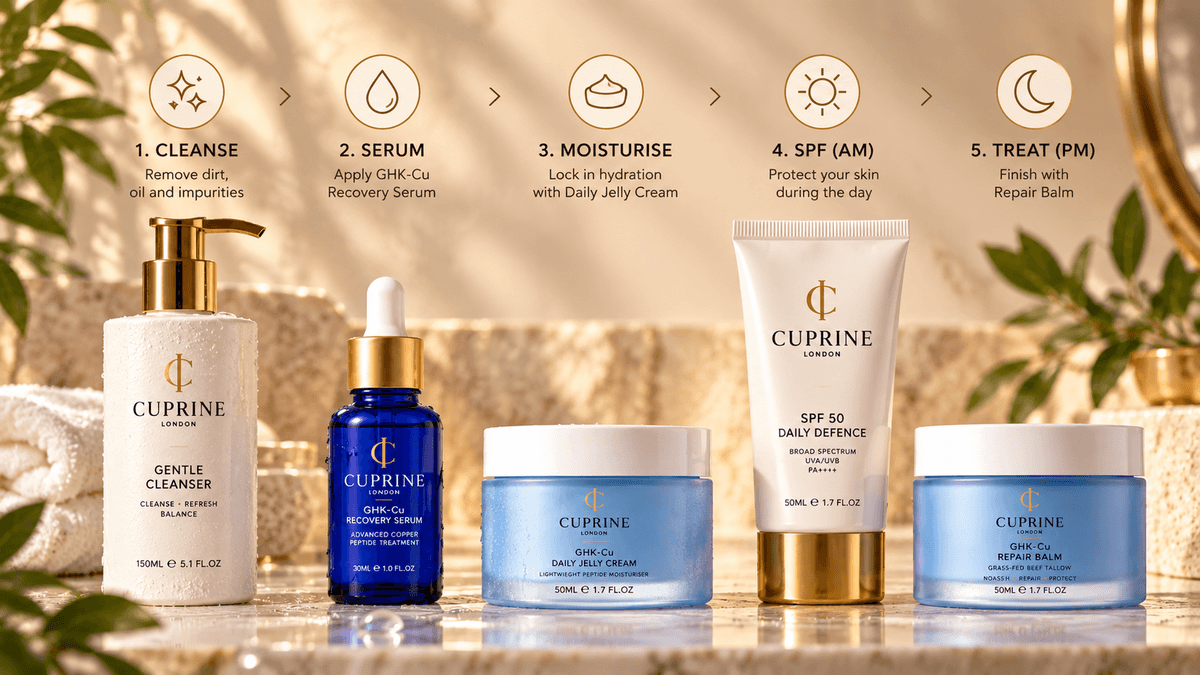
The GHK-Cu serum is a light fluid. It can only do its job if it meets skin, rather than sitting on top of oil, sunscreen, or a balm you applied too early. Technique is not a ritual for its own sake. It is how you stop wasting a bottle. Two or three drops, on clean skin that is damp rather than wet, pressed in, left for about a minute, then sealed. That is the whole method. The rest of this piece is why each part of it exists, and the mistakes that make the serum feel as if it “does nothing”.
Why this step has to go first
Water-based products do not travel well through a film of fat. If you apply the tallow balm and then the serum, the serum beads and mostly stays on the surface until it evaporates or rubs off on a pillow. The same thing happens, more quietly, if a heavy oil goes on first. The serum is first because it is the thinnest product in the routine, not because of a fashion for “actives”. The jelly cream comes after it. The balm, if you use it, comes last. The how to use page uses that same order.
Cleansing is part of going first. Makeup, sunscreen and the day’s cream are a film too. A gentle cleanser removes them. A harsh one that leaves the skin squeaky has cleaned past the point of usefulness and left the face tight before the serum even starts. You want clean, not stripped. If your cleanser stings, change the cleanser before you change the serum.
Damp, not dripping
After cleansing, pat the face until it is no longer running with water, and do not wait until it is chalk-dry. Slightly damp skin spreads a watery serum more evenly and keeps you from dragging. Soaking wet skin dilutes the two or three drops until you cannot feel where they went, and then people compensate by emptying the dropper. That is how a month’s supply becomes a fortnight.
If you like a hydrating toner, use a plain one and let it settle. Do not stack an acid toner underneath and call it “prep”. The serum is not designed as the thing you put on skin you have just stung. The barrier article is what to read if your prep step is a daily exfoliant.
How much, and where it goes
Two to three drops is enough for the face and neck. Warm them between the fingertips for a second so you are not pressing a cold bead into one spot. Then take the drops across the forehead, both cheeks, the nose, the chin, and down the neck. The under-eye area can take whatever product migrates there from the cheeks. Do not drop a full dose into the eye area on purpose. Do not forget the neck and then compare it with the face in photographs.
A tacky, sticky face means too much. Add a drop only if the skin drank the first ones and still feels dry in patches, and only once you have learned your usual amount. In a dry heated room you may want the third drop. In humid weather two is often plenty. The bottle is not a dose you have to finish to get a result.
Press, and then leave it alone
Press the serum in with flat fingers. Rubbing drags the skin and pushes product into the hairline, where it does nothing for the face. Pressing takes ten or fifteen seconds. Then stop touching it. People blot, fan and wipe because a serum feels wet, and then they complain it did not absorb. Give it about a minute. You are not waiting for a chemical reaction you can see. You are letting a thin watery layer settle before a cream lands on it.
If you are in a hurry, the minute still matters more than a second coat. Skip the extra drops. Do the cream. In the morning, do the sunscreen even if you are late. A perfect serum routine with no sunscreen is a weaker routine than a slightly rushed one that includes SPF.
What goes on top
The jelly cream is the default next step, morning and night. It carries GHK-Cu as well, so you are not diluting the point of the routine by moisturising. Use a pea, spread it, and let it settle before sunscreen or makeup. If you press cream into serum that is still dripping, the two mix into a slippery layer that pills under makeup. That is the usual reason a routine “pills”. It is timing, not a faulty bottle.
At night, dry areas can take the tallow balm last. Warm a pea until it turns clear and press. Do not put the balm on the serum and skip the cream unless you already know the balm alone is enough for you. Do not put the balm on first. In the morning, most people skip the balm so sunscreen and makeup have a cream to sit on, not a lipid coat. A very dry face can take a thin layer of balm, but it has to settle before SPF, and many people find that too heavy for daytime. The morning and evening guide is the split in full.
Sunscreen, makeup, and the things people sandwich in
Sunscreen goes on after the cream, in the morning, every day you are in daylight. It is the last Cuprine-adjacent step, even though it is not a Cuprine bottle. Makeup goes on after sunscreen has set. If your foundation pills, wait longer between cream and SPF, and between SPF and makeup. Do not solve pilling by skipping moisturiser. You will get a tight face and the same sunscreen problem.
A vitamin C serum, an acid and a retinoid do not need to be squeezed into the same minute as GHK-Cu. If you use a retinoid and your skin already tolerates it, keep it for the evening and let the copper peptide serum be the morning step, which is the cautious split in copper peptides versus retinol. If you are new to the routine, use the serum on its own for a few weeks before you add anything else. You can read what the peptide is in what GHK-Cu is.
Mistakes that waste the bottle
Applying it over the balm. Applying it to a dripping face and then using six drops to compensate. Rubbing until the skin is pink. Wiping it off because it felt wet. Following it immediately with oil. Skipping the cream and deciding the serum “wasn’t hydrating”. Starting a peel on the same night. Any one of these will make an ordinary, well-made fluid feel disappointing. None of them are fixed by buying a stronger product.
Store the bottle out of direct sun, cap on. Use it morning and night rather than once at the weekend in a thick layer. If the skin stings and stays red, stop and look at the rest of the routine. The serum is fragrance-free, with no added alcohol, and it is still not a universal. The amount that works is the amount you will still be using in eight weeks: two or three drops, pressed in, then cream. That is maximum absorption for this formula. It is also the least theatrical version of the step.