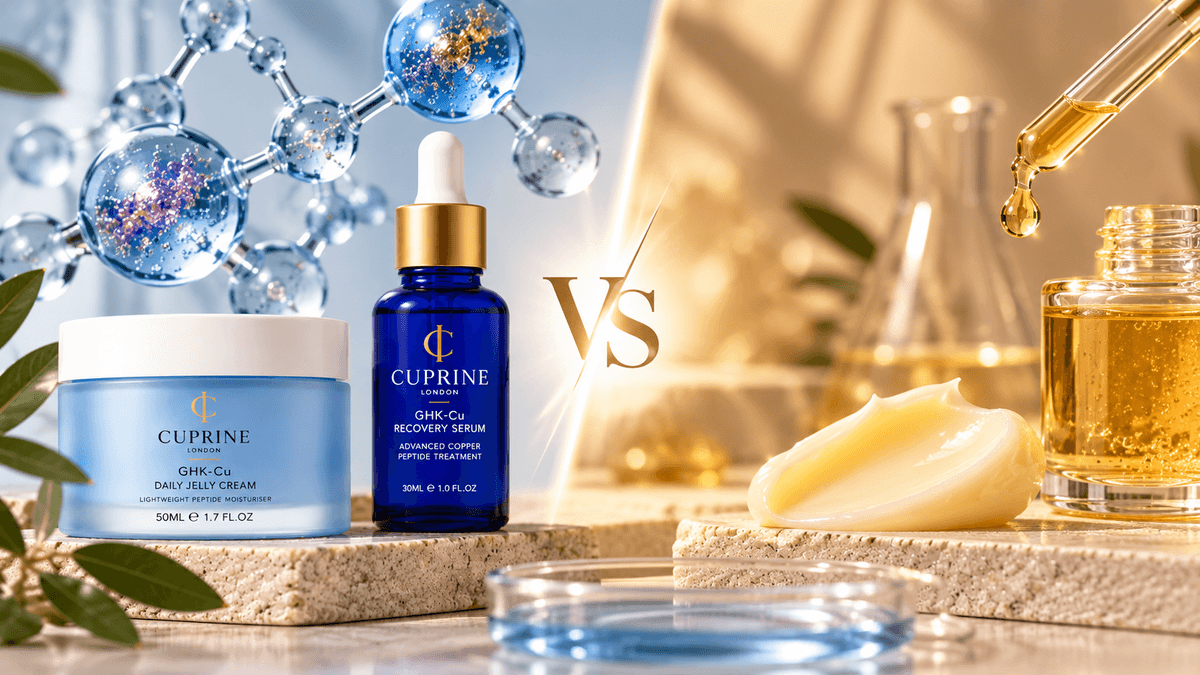
Copper peptides and retinol are both used when people want a smoother look. They are not interchangeable, and treating them as rival versions of the same bottle is how people end up irritated. Retinol can make skin feel tight while it adjusts. GHK-Cu, the copper peptide in every Cuprine formula, is comfortable enough for morning and night. Which one belongs in your routine depends on how your skin behaves, not on which ingredient is trendier this year.
How retinol works
Retinol is a form of vitamin A used in cosmetic skincare. Many people use it at night for a look that is visibly smoother. It can also leave skin dry, tight or flaky while it adjusts, so it is an ingredient the skin has to get used to. It is not the same as a prescription product, and it is still strong enough to irritate.
The adjustment has a name people recognise even if they do not enjoy it. Dryness, flaking, tightness and a low-level burn are common in the first weeks. The skin can look worse before it looks better. Retinoids also make skin more sensitive to ultraviolet light, which is why a retinoid routine is a night routine, and why sunscreen the next morning is not optional. Plenty of people get through that period and stay with retinol for years. Plenty do not. If your skin already feels thin, if it flushes or feels very dry, or if you have quit retinoids before because your face could not settle, the ingredient is the problem, not your discipline.
How GHK-Cu works
GHK-Cu is glycyl-L-histidyl-L-lysine bound to copper. It is a peptide the body already makes, identified in human plasma in 1973. On the skin, regular use can leave it looking visibly smoother, soothe the look of redness, and reduce the appearance of dark spots. The practical difference from retinol is what you feel. There is no purge, no mandatory flaking phase, and no instruction to keep it away from daylight.
That is why the GHK-Cu serum is a morning and night step. You press two or three drops onto clean skin, wait a minute, and seal it with the jelly cream. At night, dry areas can take the halal beef tallow balm last. Nothing in that order is there to strip the surface. The cream and the balm are there so the serum is not left to dry on its own. We explain the molecule itself in what GHK-Cu is.
Irritation, sun and who should wait
Choose retinol if your skin has already shown you it can tolerate vitamin A, you are happy to use it at night only, and you will not skip sunscreen. Choose copper peptide if your skin flushes easily, if a retinoid has left your face sore, or if you want one step you can use twice a day. Sensitive skin is a reason to pick a routine that does not depend on irritation.
A few situations argue for waiting on retinol even if you like the idea of it. If you are pregnant, breastfeeding, or already using a strong active, ask a doctor before you add another. GHK-Cu is made for daily use, but if you are under a doctor’s care, ask them before you add anything. No skincare brand should talk you out of that advice.
Can you use both?
You can, and you do not have to start that way. The cautious split is copper peptide in the morning and retinol at night, with cream or balm on top, and sunscreen every morning. Putting a retinoid and several other strong products on the same layer, on the first night, is how skin ends up sore. If you are new to both, start with GHK-Cu alone for a few weeks. Learn what your skin feels like when the only change is the peptide. Then, if you still want retinol, introduce it on two nights a week and keep the peptide in the morning.
There is an old forum claim that copper peptides and vitamin A cancel each other if they touch. The practical issue is irritation and pH habits, not a chemical explosion in the bathroom. Separating them by time of day removes the argument. If your skin reddens when you combine them, stop combining them. The morning and evening routine is written for the Cuprine products on their own. Add a retinoid beside that routine, not instead of the moisturiser and the sunscreen.
What “results” look like on different clocks
Retinol’s early change is often texture, and it can be the wrong kind of texture: flakes, shine where the skin is dehydrated, makeup that sits badly. Later, if you stay with it, the surface can look visibly smoother. Copper peptide’s early change is usually comfort and hydration, because you are not stripping the skin to get there. A smoother look, a softer look to redness, and a softer look to dark spots come after, on a scale of weeks to a few months. Neither product changes a deep crease in a fortnight.
Judge a copper peptide routine at eight to twelve weeks of morning and night use. Judge a retinoid on a similar horizon, and only after the irritation has settled. If you quit at week two of a retinoid because your face hurts, you have not really tested retinol. You have learned that your skin felt stripped. That is useful information. It is a reason to look at GHK-Cu, not a reason to buy a stronger retinoid.
A simple way to choose
If you want a step that leaves skin looking visibly smoother without a purge, start with the serum and the cream. If the night routine needs a richer seal, add the tallow balm. If you want all three and would rather not assemble them, the Regenerate Bundle is the set. Keep using the retinoid you already tolerate if it suits you. Do not add one because a comparison article made you feel you should.
Sunscreen stays in the routine either way. Retinol makes that non-negotiable. Copper peptide does not cancel ultraviolet light. A peptide routine without SPF is still a routine that lets the sun undo the look you are working toward. The why GHK-Cu page covers the ingredient from the formula side. This page is the choice: a night-only vitamin A, or a copper peptide you can use twice a day. Cuprine is built for the second. If you are still unsure, use the serum for a month before you buy anything else.