A long routine is easy to photograph and hard to understand. If you use a cleanser, a toner, an acid, a peptide, a retinoid, two serums, a cream, an oil and a balm, and your skin looks different in a month, you still do not know which step did the work. You also do not know which step is the one making your face feel tight. Cuprine is built as three products with three jobs: the GHK-Cu serum, the jelly cream and the halal beef tallow balm. The Regenerate Bundle is those three together. This is the case for staying with that, and for leaving the rest of the shelf alone while you find out what your skin actually does.
Why more steps make the skin harder to read
Skincare advice online rewards novelty. A new bottle every fortnight feels like progress. On the skin it is noise. Acids speed up shedding. Retinoids ask the surface to adjust, and that adjustment often looks like dryness and flaking. Fragrance, essential oils and strong scrubs add irritation that you then try to calm with the next product. By the time the face feels sore, you cannot tell the useful step from the one that should go in the bin.
A short routine has a different kind of honesty. If you change one thing, or you keep one set of products for eight to twelve weeks, the face you see in the morning is a response to that set. Comfort, a look that is visibly smoother, a softer look to redness, a softer look to dark spots: those are things you can notice, or not notice, without a spreadsheet. You cannot notice them if the routine changes every time a video tells you to.
What each step is actually for
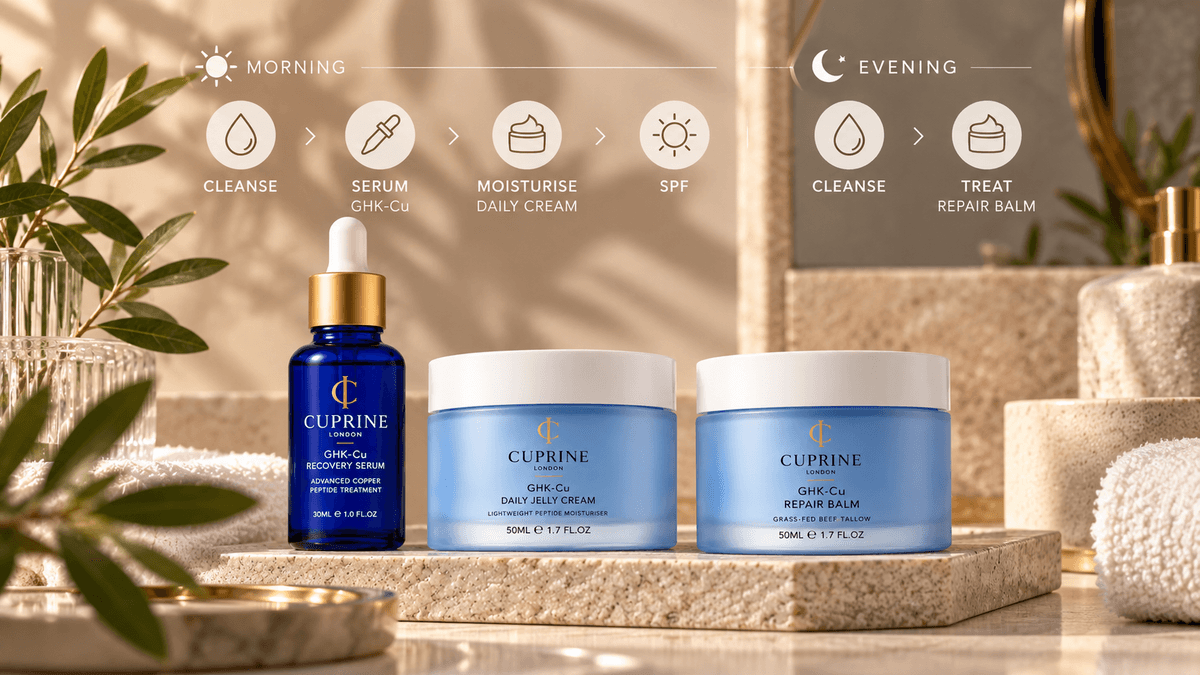
The serum is the copper peptide step. GHK-Cu, listed as Copper Tripeptide-1, sits in a light, water-based fluid with glycerin, hyaluronic acid, panthenol and centella. It goes on clean skin, before anything rich, because water-based fluid does not push through a layer of fat. Two or three drops cover the face and neck. The point is not a soaking mask. The point is a thin film the skin can take in before you seal it.
The jelly cream is the daily moisturiser. It carries the same peptide again, with ceramides, olive squalane and evening primrose oil, so you are not choosing between the copper peptide and water. A lot of people stop at the serum and then wonder why the face feels tight by lunchtime. The cream is the answer to that. It is also the product you can wear under sunscreen and under makeup without a greasy film, which is why it belongs in the morning as well as at night.
The tallow balm is the night seal for skin that is dry, tight, or comfortable by day and uncomfortable by morning. It is a balm, not a jar of plain rendered fat: shea, tallow from 100% grass-fed and finished cattle, sweet almond oil and jojoba esters, with the copper peptide in the formula, and it is halal certified. A pea, warmed between the palms until it looks clear, pressed on last. If you are oily through the centre of the face, keep it to the cheeks and any patch that flakes. If the cream is already enough, you do not have to use the balm every night. A simple routine is allowed to be even simpler.
The order is fixed, and the reason is physical
Thin product first, richer product last. Cleanse. Press the serum in and wait about a minute. Apply the cream. At night, press the balm on if you are using it. In the morning, finish with a broad-spectrum SPF 30 or higher. Sunscreen is not a Cuprine product and it is not optional. A peptide routine that skips it is a routine that lets daylight undo the look you are working toward. The how to use guide is the same order with the gestures written out. How to layer the serum is the technique piece if the minute of waiting feels fussy.
People reverse this because the balm feels like the “treatment” and the serum feels like water. Fat blocks what you put on afterwards. If the tallow goes on first, the serum sits on top of it and mostly evaporates. The cream will not save that. Order is the whole method. Texture tells you the order if you forget the names: watery, then soft cream, then balm.
How much is enough
More product does not speed anything up. A tacky face after the serum means you used too many drops. A white cast from the cream means the pea was a walnut. A balm that still looks glossy twenty minutes later was applied like a mask. The useful amounts are small because the formulas are concentrated enough to cover skin without a thick coat, and because a thick coat is what makes people decide a product “does not suit them” when the real problem was the scoop.
Hands, neck and the area under the jaw count. People treat the face as a circle from the brows to the chin and then wonder why the neck looks different. Two or three drops includes the neck if you spread them. If you want a separate amount for the neck, use one more drop, not half the dropper. The chest, if you include it, takes the cream more happily than a flood of serum.
What to leave out while you learn the routine
Leave out a second acid, a daily scrub, and a new retinoid started on the same night as everything else. If you already use a retinoid and your skin has settled with it, you can keep it at night and use the copper peptide serum in the morning. That split is covered in copper peptides versus retinol. Starting both from zero, on the same evening, on dry skin, is how a simple routine stops being simple.
Leave out essential oils “for glow”, and leave out a foaming cleanser that makes the face squeak. The squeak is the barrier feeling stripped, not clean. A gentle cleanser, then the three steps, is the whole evening. Fragrance-free formulas are easier to read for the same reason: if the skin stings, you are not guessing whether a perfume did it. Cuprine products are fragrance-free and have no added alcohol. That is a formulation choice, not a claim that the routine can replace sunscreen or a doctor.
How long to stay with it
Hydration and a softer feel can show up in the first few weeks, because you have stopped stripping the skin and you are sealing water in. A look that is visibly smoother, with a softer look to redness and dark spots, is slower. Give the same morning and night routine eight to twelve weeks before you decide it has done nothing. Eight weeks with GHK-Cu is about how to judge that period without inventing a transformation that is not there yet.
Consistency beats intensity. Two or three drops every night for three months will tell you more than a week of layering everything you own. If you miss a morning, use the cream and sunscreen and carry on that night. If you miss three days, start again. Do not “catch up” with extra drops. The skin does not store the ones you skipped.
When a short routine is still the wrong routine
If the skin stings and stays red, stop and look at the cleanser and at anything else in the bathroom before you blame the peptide. GHK-Cu is generally comfortable, including on skin people call sensitive, and it still does not suit everyone. If you are under a doctor’s care for a skin condition, ask them before you add a new product. A brand page is not a clinic.
If you are very oily and rich textures bother you, use the serum and the cream and leave the balm for the driest patches, or skip it. If you want the copper peptide without any animal fat, the serum and cream are the pair. The balm is the optional night seal, not a test of commitment. The routine works when the products you actually use have a job, an order, and enough weeks. That is the whole argument against the ten-step shelf.