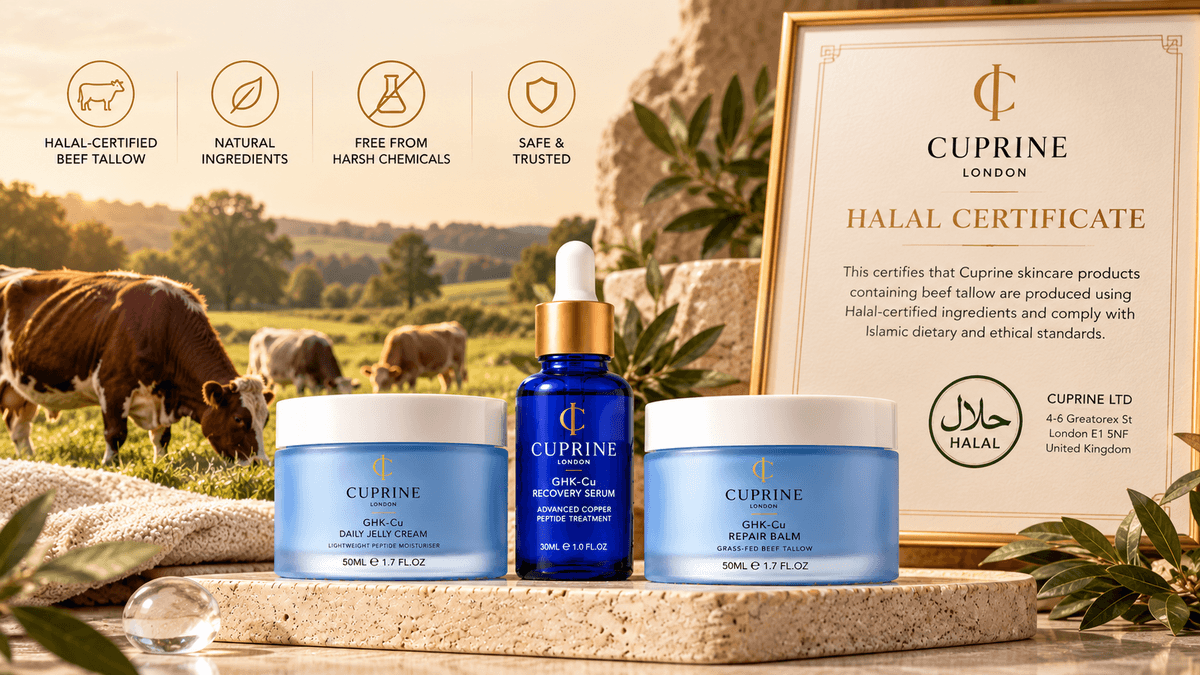
Halal is a religious standard, and it is also a supply-chain standard. For many people who buy Cuprine it is not a preference. It decides whether a product can come into the house. For anyone else it is still a useful question: who made this ingredient, from what, and who checked. This piece is what we mean by the halal promise, what it does and does not guarantee, and why the beef tallow balm is the product where that promise has to be the most specific.
What the word is doing on a skincare jar
Halal means permissible. In food, people know the outline: the animal, the slaughter, the handling, and the absence of anything prohibited, including pork and intoxicating alcohol. On skin, the same worries apply, because a product stays on the body and because ingredients are processed long before they reach a bottle. A plant oil can be fine in itself and still pass through a solvent or a processing aid that is not. An animal fat can be an excellent lipid and still be unacceptable if the animal and the method were not.
A brand can write “clean” on a box without answering any of that. Clean is not a regulated word. Halal certification is a standard with rules and an audit, which is a different kind of sentence. We would rather be held to the second. The shorter version of why the fat itself is in the jar is in why we chose halal beef tallow. This page is the promise around it.
Ingredients, and what we keep out
GHK-Cu is made in a lab. On the label it is Copper Tripeptide-1. It is not taken from blood, and it is not an animal ingredient. That matters if you want the peptide and you do not want animal fat: the serum and the jelly cream are the pair. The balm is the product that contains tallow, and that tallow is the animal ingredient we name rather than hide inside a blend.
The formulas are fragrance-free. There is no added alcohol of the kind used to make a product feel light and then evaporate. We do not describe them as alcohol-free in the loose marketing sense, because the balm’s ingredient list includes fatty alcohols, cetyl alcohol and cetearyl alcohol, which are waxy emulsifiers, not a drink and not a solvent. Saying “alcohol-free” would be sloppy. Saying there is no added alcohol is the accurate line. We also do not claim the cream is silicone-free. Its ingredient list includes a silicone crosspolymer. The INCI is on each product page so you can read it yourself.
The animal ingredient, traced
The tallow comes from 100% grass-fed and finished cattle, and it is halal certified. Grass-fed and finished means the diet stays forage through to slaughter, rather than a grass-fed label that ends in a grain lot. Certification is what covers the slaughter, the handling, and the chain after that. We are not going to invent a certificate number on a blog. The standard we hold the balm to is halal certification of that supply, and the jar should be read in that light.
Traceability is the part people skip when they see a green leaf on a label. It means the fat can be followed back, batch by batch, rather than bought as an anonymous block of “tallow” from a commodity trader and decanted into a pretty pot. Commodity fat is cheaper. It is also how a brand ends up unable to answer a straightforward question about the animal. If you are buying the balm because the answer matters, the certification is the answer. If you are buying it because your skin is dry, you still get that standard. You do not get a weaker jar for a different reason.
What certification is not
It is not a medical claim. A halal balm does not treat a condition, and it does not make GHK-Cu into a drug. The cosmetic aims stay the same as the rest of Cuprine: a look that is visibly smoother, a softer look to redness, a softer look to dark spots, from regular use. Certification does not speed that up and it does not replace sunscreen.
It is not a promise that every texture will suit every face. The balm is rich. If you are very oily, use it on dry patches or skip it. A halal routine can be the serum and cream alone. It is not a promise of “chemical-free”, which is not a meaningful phrase for a formulated product that contains glycerin, peptides and preservatives. Preservatives are how a water-based cream stays usable. We would rather name them in the INCI than pretend a jar of water and oil keeps itself.
It is also not animal testing. Halal and cruelty-free are different questions. Cuprine products are not tested on animals. That sentence stands on its own. It is not proved by the halal audit, and the halal audit is not proved by it. Both are part of how we make the range. Neither is a slogan we swap in when we are short of a fact.
Serum and cream, without tallow
People assume the whole range is a tallow range. It is not. The serum is a light fluid: glycerin, hyaluronic acid, panthenol, centella, and Copper Tripeptide-1. The cream is a moisturiser with ceramides, olive squalane and evening primrose oil, and the same peptide. They are made to the same halal standard and they do not contain beef fat. If someone in your household will not use an animal ingredient, those two are the routine. The Regenerate Bundle includes the balm, so it is the wrong set for that household. Buy the two bottles instead.
The order does not change. Serum on clean skin, cream after, balm last and only if you use it, sunscreen in the morning. The morning and evening guide is the practical version. Halal is the standard of the ingredients. It is not a different way of applying them.
If this is not your faith
You can still care that an animal fat was traced, that the cattle were grass-fed and finished, and that a third party had rules to check. You can also ignore the theology and read the INCI. Both are respectable reasons to buy or not to buy. What is not respectable is a brand using the word as decoration. If we say halal certified tallow, that is a claim you should be able to take seriously, which is why we keep it on the balm and on the halal promise page rather than scattering it over every sentence of the site.
Designed in London, made to that standard, and labelled so you can see the tallow rather than discover it later. If the balm is the product you came for, start with a pea at night and judge it in the morning. If the peptide is what you came for, start with the serum. The promise is that neither bottle asks you to guess what you put on your face.